
Strata Residents Are the Last Australians Who Can't Escape Petrol Prices

The tragedy unfolding in the Middle East is a sharp reminder of what Australians have always known but rarely felt this directly: keeping our cars moving depends on a supply chain that spans the globe, and we have no control over it. Petrol prices reflect that helplessness every time you pull into a servo. Global conflict, shipping disruptions, decisions made in rooms we'll never be in — all of it lands on the same number on the same sign.
For most Australians, there's now a practical response to that. For strata residents, it's more complicated.
Everyone with a driveway has an exit
Anyone with a house and a driveway can buy an EV, plug it in overnight, and wake up to a full charge. The cost per kilometre drops. The exposure to global oil markets drops with it. Petrol prices are doing the work that no amount of green marketing ever could, and Google Trends data for Australia shows search interest in "EV charging" reaching its highest point in five years in March 2026, a sharp climb from where it sat just twelve months ago. People aren't just curious. They're ready to act.
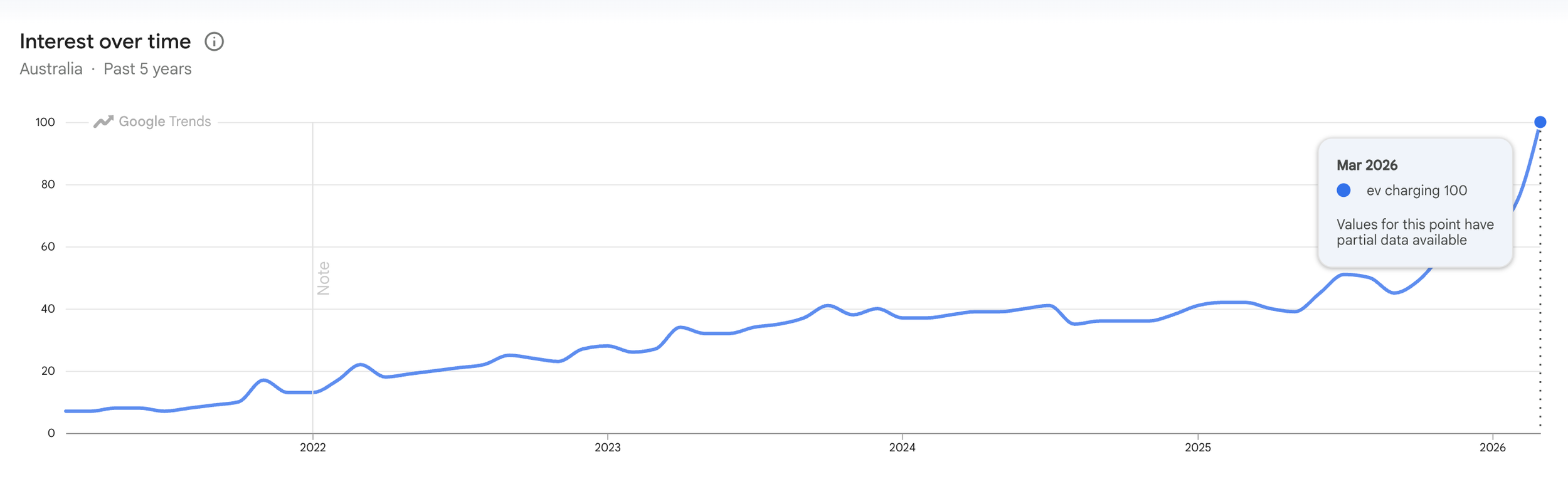
Source: Google Trends
But wanting an EV and being able to charge one at home are two different things when home is a strata building. You can buy the car. The infrastructure question belongs to the owners corporation — and until the OC moves, residents are stuck filling up at the servo like it's 2019.
The decision sitting on the committee table
Owners corporations aren't dragging their feet out of indifference. The hesitation is usually practical: who pays, how much, what happens when more residents want charging down the track, and whether the building's electrical infrastructure can handle it.
These are fair questions, and they have straightforward answers.
Shared infrastructure in a strata building typically costs around $200 per lot for the owners corporation — a one-time investment in the shared asset, not an ongoing charge. Individual residents who want a charge point pay for their own connection, around $800, and pay only for the electricity they actually use, billed automatically. The owners corporation doesn't carry costs on behalf of residents who don't yet own an EV. As more residents make the switch, the system scales to meet them.
The approach that works best in strata uses trickle charging through standard power outlets, with individual metering and smart load balancing built in. It doesn't require a major electrical upgrade. It's a fraction of the cost of the Level 2 systems that tend to get quoted first, and it's already running in strata buildings across NSW.
ReadySteadyPlug: the solution is already here. Strata just needs to act.
The residents asking about EV charging today are not outliers. According to the Australian Bureau of Statistics Survey of Motor Vehicle Use, the average Australian drives around 11,000 kilometres a year. At current petrol prices, that's a number every driver in your building is quietly doing in their head every time they fill up. The ones who can charge at home have already found their way out. The ones in strata are still waiting for the building to catch up.
ReadySteadyPlug was built specifically for this problem. The technology is proven, the cost model is fair, and it's already operating in strata buildings across NSW. A strata committee that acts now isn't getting ahead of a distant trend — it's responding to something residents are already feeling in their wallets, every week.
If you'd like to understand what EV charging could look like in your building, we're happy to come out and take a look. Get in touch to arrange a free site assessment.
