
Do You Really Need a 7kW Charger in Your Apartment Car Park?
The short answer is: probably not.
But that is not a very satisfying answer, so let's go through the numbers properly. Because the case for 7kW wall chargers in apartment buildings is made almost entirely by people who sell 7kW wall chargers, and the actual data on how Australians drive tells a different story.
If you want to find more about the different types of EV chargers, read here »
What a 7kW charger actually does
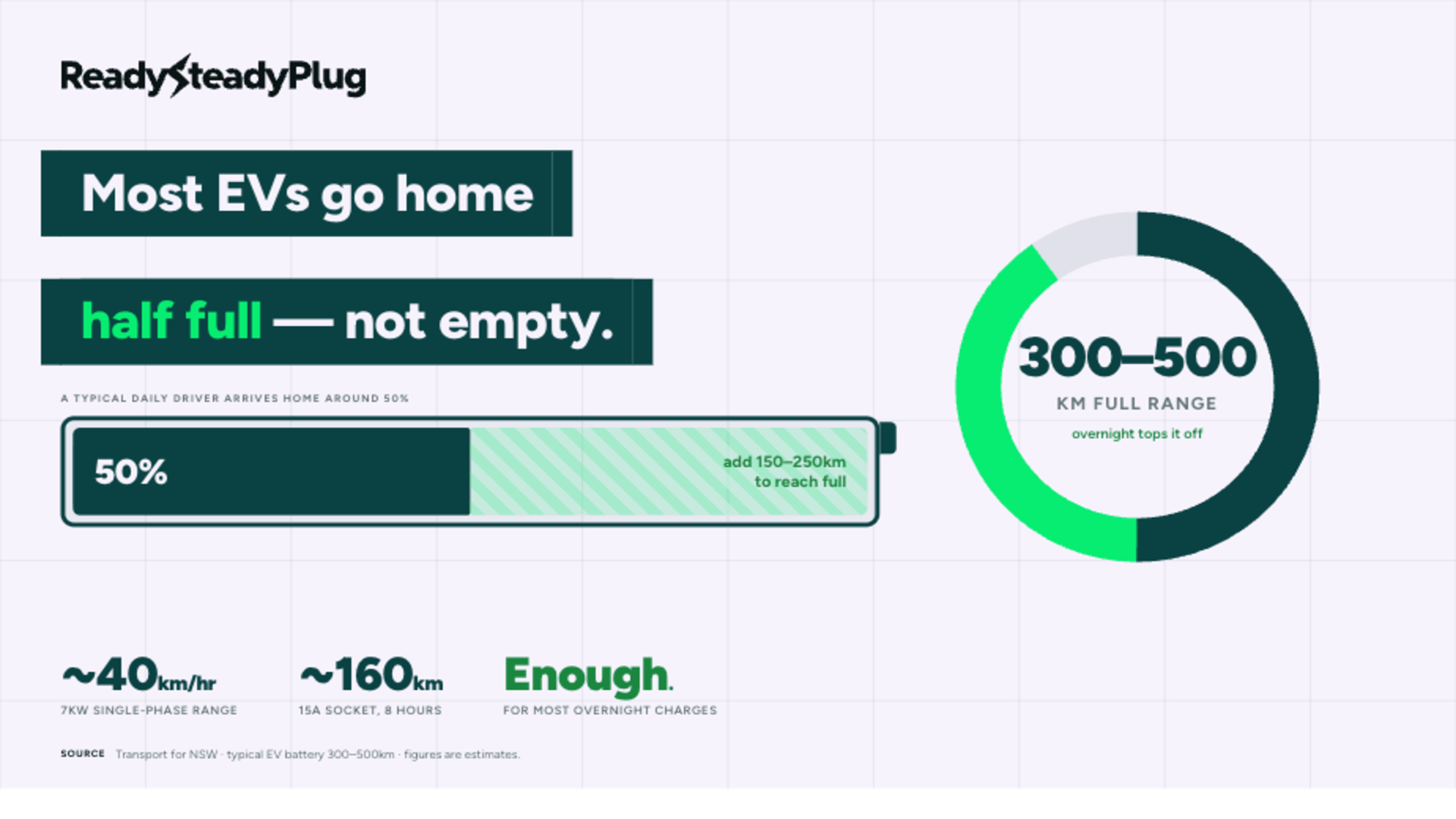
A 7kW AC wall charger (what most people call a Level 2 charger) can add roughly 30 to 50km of driving range per hour, depending on the vehicle. Transport for NSW puts the typical single-phase Level 2 range at around 40km per hour. Over a full overnight charge of eight hours, that is 240 to 400km of range added.
That sounds impressive. But here is the thing: most EVs on the market today have a range of 300 to 500km on a full battery. If your battery is already at 50% when you get home, which is typical for most daily drivers, you only need to add 150 to 250km overnight. A standard 15A power socket, running for eight hours, gives you around 160km. That is enough. More than enough.
Read more about EV charging for Strata »
How much do Australians actually drive?

The ABS Survey of Motor Vehicle Use puts average Australian passenger vehicle distance at around 12,100km per year, or roughly 30 to 35km per day. That is a commute, a school run, a few errands. It is not a long-haul journey.
A 15A GPO running overnight adds around 160km. You would need to drive that 30km daily average for nearly a week before you would use up what a single overnight Level 1 charge provides.
So who actually needs a 7kW charger at home? Realistically, it is high-mileage drivers doing 100km or more per day, or people who need a full charge in less than six hours for some other reason. That describes a small fraction of apartment residents.
Why 7kW gets oversold
Part of this is marketing. Hardware manufacturers and installers make more money on a 7kW unit and its associated installation than on a GPO. The faster speed is a genuine feature, and it does matter in some situations. But it gets presented as a requirement when it is actually a preference.
The other part is that people confuse public charging behaviour with home charging behaviour. At a public charger, speed matters a lot, because you are paying by time or you need to get back on the road quickly. At home, your car is parked anyway. It does not matter if it charges in four hours or eight hours, as long as it is full by morning.
What 7kW costs a strata building
Installing a 7kW charger in a standalone house is relatively straightforward. Installing a 7kW charger in a strata building is a different proposition entirely.
The electrical infrastructure in most older apartment buildings was not designed to support multiple high-draw devices running simultaneously. A 7kW charger draws roughly the same continuous load as an electric cooktop. Multiply that across ten or twenty residents charging overnight, and you are looking at a significant load on the building's switchboard.
That usually means a switchboard upgrade. It means high-capacity cabling runs from the main switchboard to each car space. It means a load management system to prevent the building from tripping its own power supply. Energy NSW describes this as an "EV charging backbone" and lists out the components: high-capacity feeds, intermediate distribution boards, cable trays or busways. All of that cost falls on the owners corporation, before a single resident plugs in.
A managed 15A system, by contrast, works within the building's existing electrical capacity in most cases. No switchboard upgrade. No expensive cabling backbone. The owners corporation installs the shared infrastructure; individual residents pay for their own connection and their own electricity.
When 7kW is the right choice
To be clear: there are situations where Level 2 makes sense in a strata building.
New builds where the electrical infrastructure has been designed with EV charging in mind from the start.
Buildings where a significant majority of residents already own EVs and need faster charging.
High-mileage residents who can demonstrate they genuinely cannot get enough range from overnight Level 1 charging.
But for the average building with mixed EV uptake, rolling out 7kW infrastructure for all car spaces, at the owners corporation's expense, is a significant investment for a problem that does not actually exist at scale yet.
The smarter starting point
Most buildings are better served by infrastructure that can grow with demand, rather than infrastructure sized for a future that has not arrived yet. A managed Level 1 system lets you start with the residents who have EVs today, expand as more residents get them, and avoid a large upfront spend that the majority of owners may not want to carry.
If your building is starting to have this conversation, the first question to ask is not 'how fast can we charge?' It is 'how many residents actually need a fast charge, and what does the rest of the building need to accommodate them?'
We have helped buildings across NSW work through exactly that question. Get in touch if you would like to talk it through.
