
What Is Dynamic Load Management in EV Charging? A Plain-English Guide for Strata
If your building has had its first EV charging request, you have probably also had the first worry that comes with it: can the building's power actually handle it?
It is a fair question. Apartment buildings were not wired with a dozen EVs in mind. The good news is that the answer is almost always yes, and the reason is a piece of technology called dynamic load management. Here is what it is, in plain terms, and why it matters for owners corporations and strata managers.
The core problem: your building only has so much power
Every building is connected to the grid with a fixed amount of capacity. That capacity is already being shared by everything that runs in the building: lifts, lights, water pumps, hot water, ventilation, air conditioning, and every cooktop and appliance behind every apartment door.
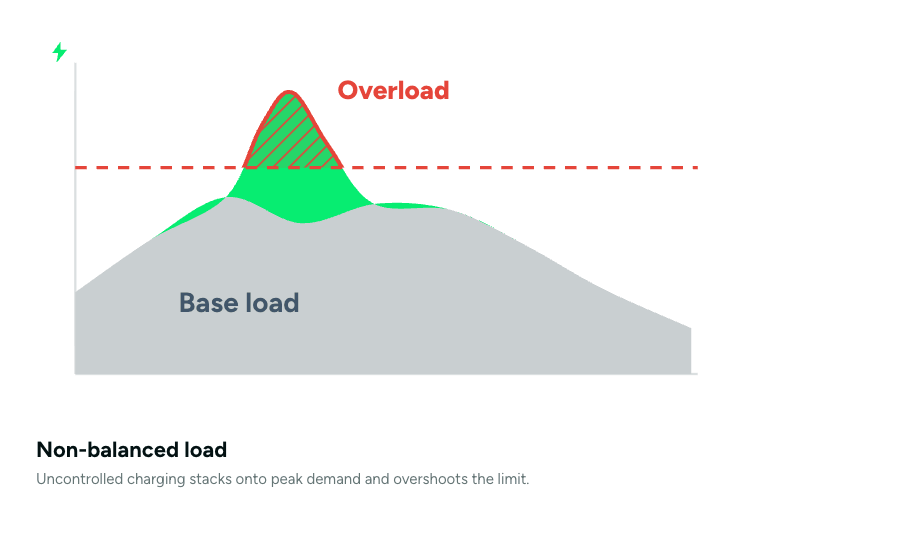
That demand is not steady. It rises and falls across the day in fairly predictable ways. Mornings and early evenings tend to be busy. Overnight is quiet.
Now add EV charging. A single home-style charger can draw around 7kW. Put eight or ten of those in the car park, let them all run flat out at once on top of a weekday dinner peak, and you can push the building past its supply limit. That is when you get tripped feeders, and in the worst case it is what forces an expensive switchboard or mains upgrade before any chargers can go in at all.
This is the wall most buildings hit. It is also the wall dynamic load management is designed to remove.
What dynamic load management actually does
Dynamic load management, often shortened to DLM and sometimes called load balancing, is a controller that sits across your building's supply and does three things continuously:
It measures how much power the whole building is using, in real time.
It works out how much spare capacity is left.
It hands that spare capacity to the EV chargers, and only that spare capacity.
When the building gets busy, EV charging automatically slows or briefly pauses. When demand drops away, usually overnight, charging ramps back up to full speed. The building's supply limit is never crossed, because the system is checking and adjusting constantly rather than hoping for the best.
In other words, EV charging fits into the power you already have, instead of demanding more.
Static versus dynamic, and why the difference matters
You may also hear about static load management. It is worth knowing the difference, because it is the difference between a system that works for strata and one that quietly causes problems.
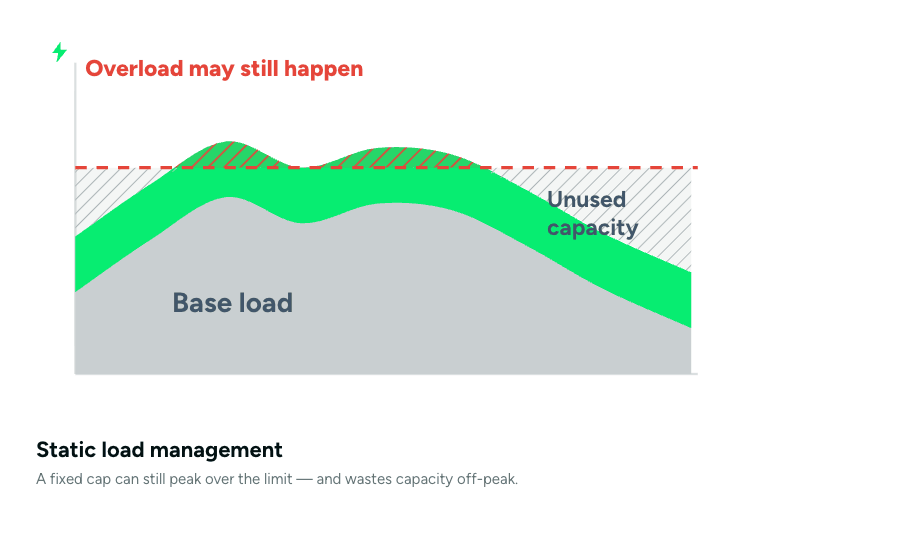
Static load management sets a fixed cap on the chargers and leaves it there. The trouble is that a building's real load is never fixed. So a static cap has to be set low enough to be safe at the busiest moment of the busiest day, which means it wastes most of the capacity that is actually free overnight. And if it is set even slightly too high, it can still overshoot the limit during a peak.
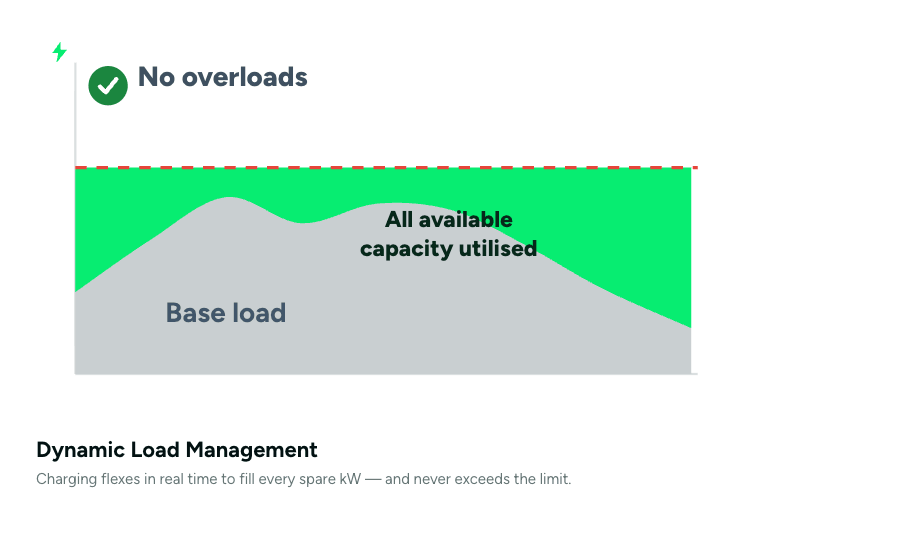
Dynamic load management has no fixed cap. It moves with the building moment to moment, filling every spare kilowatt when the building is quiet and easing off the instant the building gets busy. For a shared building with changing demand all day, that is the only approach that uses your capacity well and keeps you safe at the same time.
Why this matters for owners corporations and strata managers
Beyond the technical safety, dynamic load management changes the economics and the politics of EV charging in a strata building.
It usually removes the switchboard upgrade. The single biggest cost in most EV charging proposals is upgrading the building's electrical supply. Because DLM works inside your existing capacity, that upgrade is avoidable in most buildings. That takes the scariest line item off the table before it ever reaches an AGM.
It keeps you within your demand charges. Many buildings are billed not just on the energy they use but on their peak demand. Uncontrolled charging can spike that peak and lift the whole building's bill. A good DLM system is engineered to stay within your contracted maximum demand, so EV charging does not quietly inflate the common-property power bill.
It lets you grow one bay at a time. Without load management, every new charger can mean another engineering review and another round of works. With DLM, you can add bays into the spare headroom as more residents go electric, rather than re-engineering the building each time.
It is fairer. Instead of the first few residents grabbing all the capacity and leaving nothing for anyone else, the system shares the available power across everyone who is plugged in. EV charging becomes a shared building service rather than a first-come, first-served scramble.
What this looks like in a real building
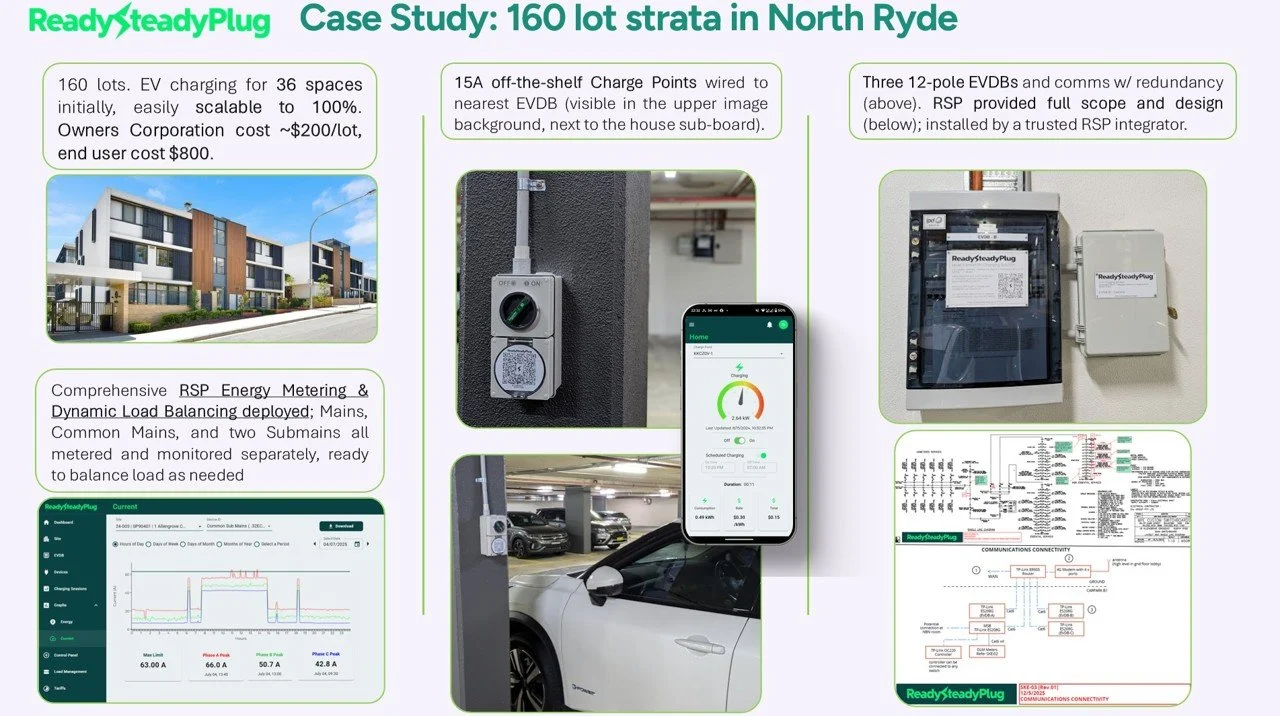
This is not theory. At a 160-lot building in North Ryde, NSW, we run RSP energy metering across four levels at once: the mains, the common mains, and two separate sub-mains, with every charge point individually metered. That layered view is what lets the system see exactly where the building's power is going at any moment, and feed EV charging into the capacity that is genuinely free rather than guessing at a fixed cap. The site was set up to balance load as demand grows, so bays can be added as more residents go electric without going back to the drawing board on the building's supply. You can see the full setup in our North Ryde case study.
What do residents actually notice?
This is usually the next question, and it is a reasonable one. If charging slows down during peaks, will people's cars be left flat?
In practice, almost never. Most EVs are plugged in overnight and need far less than a full charge to top up a normal day's driving. Overnight is exactly when the building is quietest and the most capacity is free, so the great majority of charging happens at full speed while everyone is asleep. During a brief evening peak the charge rate may ease for a while, then recover automatically. In normal use, most residents notice nothing.
How do you find out if your building is ready?
The honest answer is that it depends on your building's real load profile, which is something to measure rather than guess. Two simple next steps:
Get a rough sense of the numbers with our EV charging capacity calculator, which estimates how many EVs your building could charge.
For the full technical picture of how the controller works, including the live demo and the four-level metering setup, see our Dynamic Load Management page.
Dynamic load management is the reason EV charging in apartment buildings has stopped being a major electrical project and become something most buildings can simply add. It lets you say yes to residents without saying yes to a switchboard upgrade.
If you want to know what your specific building can do, the best starting point is a site assessment, where we measure your actual electrical capacity, parking layout, and rollout options before anything is designed. You can book a site visit here.
ReadySteadyPlug provides managed EV charging for strata and apartment buildings across Australia. Learn more about how it works or read our complete guide to strata EV charging.
