
What Strata Managers Need to Know About EV Charging Requests
EV charging requests are becoming a regular part of strata management. If you are not already fielding them, you will be soon. And while the process is not complicated, there are a few things worth understanding before the first formal request lands on your desk.
This guide is for strata managers who want to handle EV charging requests efficiently, fairly, and in a way that protects the owners corporation.
Why requests are increasing
EV sales in Australia have been growing steadily, and apartment residents are catching up with the rest of the market.
The Strata Schemes Legislation Amendment (Miscellaneous) Bill 2025 (often called the "Right to Charge" bill) was introduced in NSW Parliament in November 2025. If passed, it will give owners a legal right to install EV charging in their lot, and will accelerate request volumes further. Residents will have a clearer pathway to approval, and committees will have new obligations around response timeframes.
For strata managers, this means EV charging is moving from a niche request to a standard part of the job.
Your key obligations under the current rules
Under NSW strata law, EV charging infrastructure is classified as a sustainability infrastructure upgrade under section 132B of the Strata Schemes Management Act 2015. This changes the voting threshold at a general meeting: a sustainability infrastructure resolution passes unless 50% or more of votes cast are against it, rather than the 75% special resolution previously required.
Practically, this means:
A determined group of EV-owning residents can push a charging motion through at an AGM without needing a majority of all owners to agree.
Committees cannot simply table the issue indefinitely. Once a motion is formally proposed, it needs to go to a vote.
Under the proposed Right to Charge legislation, individual owners will be able to notify the committee of their intent to install. If the committee does not respond within three months, the installation is deemed approved.
That last point is the most important new obligation. Strata managers will need a process for logging, tracking, and responding to formal EV charger installation notices within the three-month window.
Read more: NSW Right to Charge: What the Law Means for Strata Buildings (And What It Doesn't Fix)
The most common problems with ad-hoc EV charger request approvals
The biggest risk in EV charging management is approving individual requests without a building-wide plan.
Here is how it tends to go wrong:
The first request comes in. The committee approves it without much thought. The second follows, also approved. By the fourth or fifth, the building's electrical capacity is running low. The committee wants to say no, but has no documented basis for doing so. A dispute follows.
The other common problem is metering. If a resident installs a charger connected to common property circuits, their electricity usage gets spread across the whole building's bill. That creates fairness issues and is genuinely hard to unwind once it is in place.
The cleanest way to avoid both problems is to move toward a building-wide system with individual metering, rather than managing each request as a standalone.
What to look for in an EV charging provider
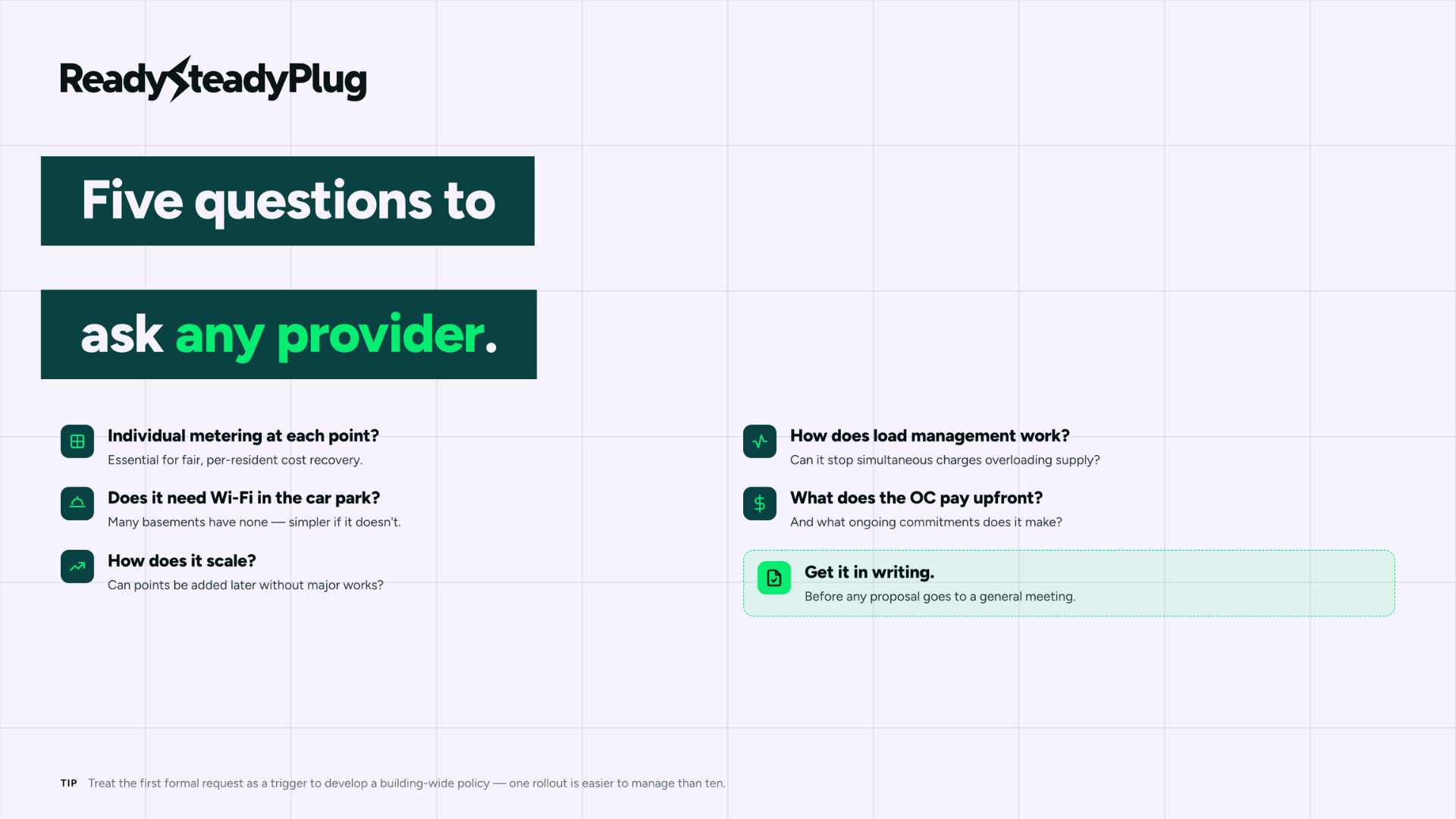
When a building is ready to go to market, strata managers will often be involved in shortlisting providers. A few things worth checking:
Does the system include individual metering at each charge point? This is essential for fair cost recovery.
How does the system handle load management? Can it prevent multiple simultaneous high-draw charges from overloading the building's supply?
Does it require Wi-Fi or cellular coverage in the car park? Many basement car parks have none. A system that does not need it is significantly simpler to deploy.
What are the owners corporation's upfront costs? And what ongoing commitments does the OC make?
How does the system scale? Can new charge points be added without major additional works?
Get these answers in writing before any proposal goes to a general meeting. It makes the committee's decision easier and protects you if questions arise later.
How to handle the first formal request in your building
If a resident submits a formal written notice of intent to install, treat it as a time-sensitive document. Log the date received and note the three-month response window (once the Right to Charge legislation passes).
From there:
Check whether the building has had an electrical capacity assessment. If not, commission one before responding.
Review any existing by-laws that touch on EV charging. Under the new legislation, by-laws that unreasonably restrict charger installations will have no effect. Your strata lawyer should advise on this.
Consult with the committee about whether to respond to this as an individual request or use it as a trigger to develop a building-wide policy.
The second option is almost always better. One well-managed rollout is easier than ten ad-hoc approvals managed separately. That’s where we can help.
The role of the strata manager in a building-wide rollout
Once a building decides to go ahead with a managed EV charging system, the strata manager's role is largely coordination: making sure the general meeting motion is properly drafted, that the provider's proposal is clearly communicated to owners, and that the installation process is signed off correctly.
After installation, the ongoing management burden should be minimal if the system has good reporting tools. Individual billing goes direct to residents. Load management runs automatically. The strata manager's job is to make sure the system is working and that there is a clear point of contact for any issues.
If you have a building where EV charging is coming up and you want a clear picture of the options, we work with strata managers directly and can help you put together a proposal that is ready for a general meeting.
