
Are EV chargers fire safe? What strata buildings need to know in 2026
If you sit on an Owners Corporation committee or manage a strata portfolio, you have almost certainly heard the question. Sometimes it comes from a worried resident, sometimes from an insurer, sometimes from a committee member who saw a viral video of a Tesla on fire.
The question itself is reasonable. The answer, when you look at the actual data, is not what most people expect.
Here is what the credible Australian and international research says about EV charger fire safety, and what it means for buildings considering EV charging.
The headline: EV fires are rare, and charging is rarely the cause
The most authoritative Australian source on this is EV FireSafe, a private company funded by the Australian Department of Defence to research electric vehicle battery fires. Their data is referenced by Fire and Rescue NSW, the NFPA in the US, the UK National Fire Chiefs Council and EV manufacturers including Tesla.
The numbers, as of early 2026:
13 verified EV battery fires in Australia since 2021
473,000 plug-in electric vehicles on Australian roads
That works out to roughly 3 in 100,000 EVs catching fire
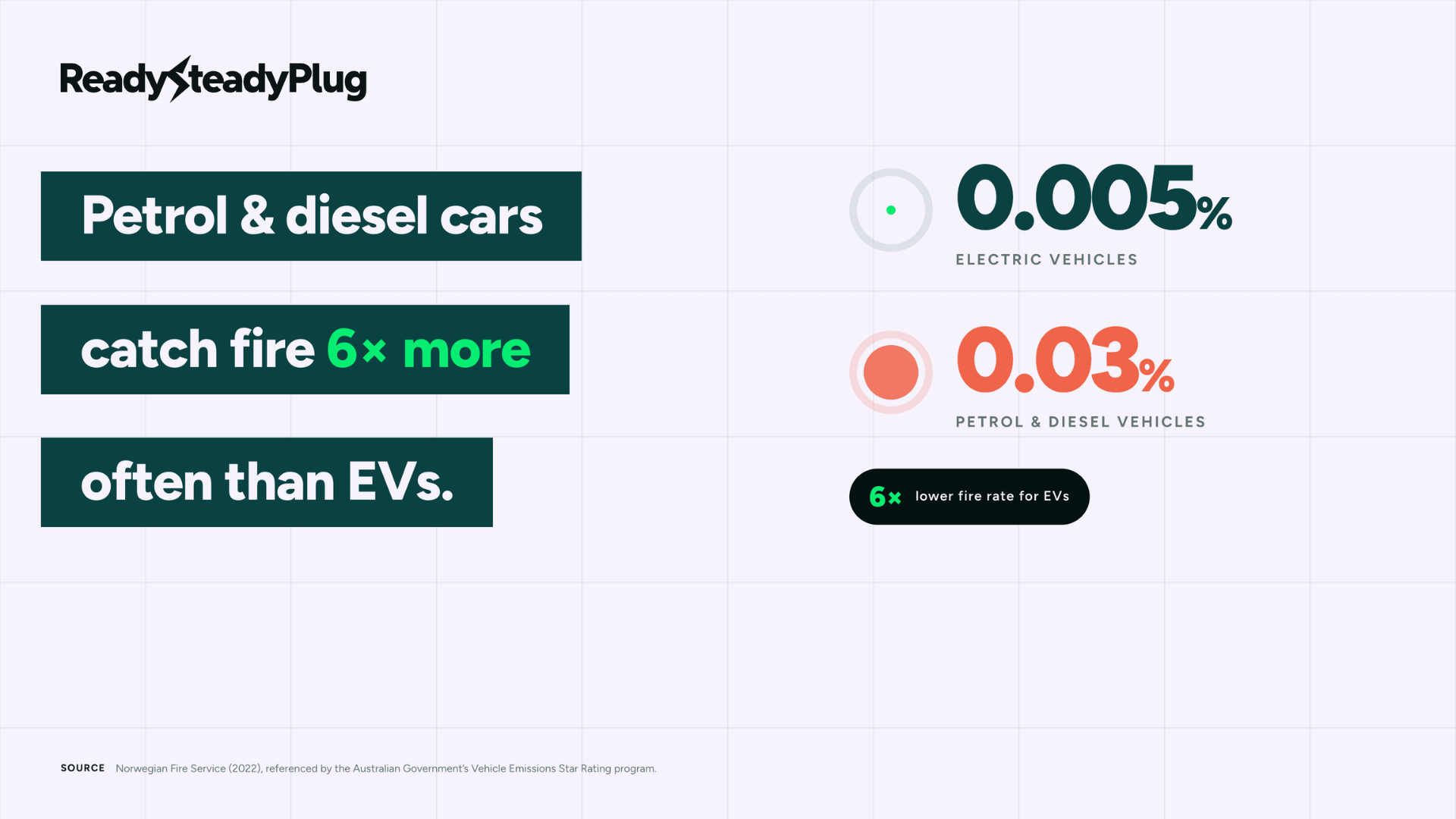
Source: Norwegian Fire Service (2022), referenced by the Australian Government's Vehicle Emissions Star Rating program — vehicleemissions.gov.au
For comparison, Fire and Rescue NSW attended almost 11,582 vehicle fires in total since the start of the 2021/2022 financial year. Petrol and diesel cars are catching fire at a much higher rate than EVs, both in Australia and internationally.
Norwegian Fire Service data from 2022 showed a fire rate of 0.005% for EVs compared to 0.03% for petrol and diesel vehicles, according to the Australian Government's Vehicle Emissions Star Rating program. That is six times lower for EVs.
Of the EV fires that did happen, almost none were caused by charging
This is the part most committees never hear.
Of the 13 Australian EV fires:
3 were caused by external fires
2 by arson
4 from high-speed collisions
3 from unknown causes
3 were charging at the time, but in all three cases the cause of the fire was unrelated to charging
In other words, when an EV does catch fire, the charger is almost never the trigger. EV FireSafe's research indicates the majority of charging-connected EV battery fires occur because the vehicle was previously damaged, then connected to a charger. The damage came first.
The real lithium-ion fire risk in apartment buildings is not EVs
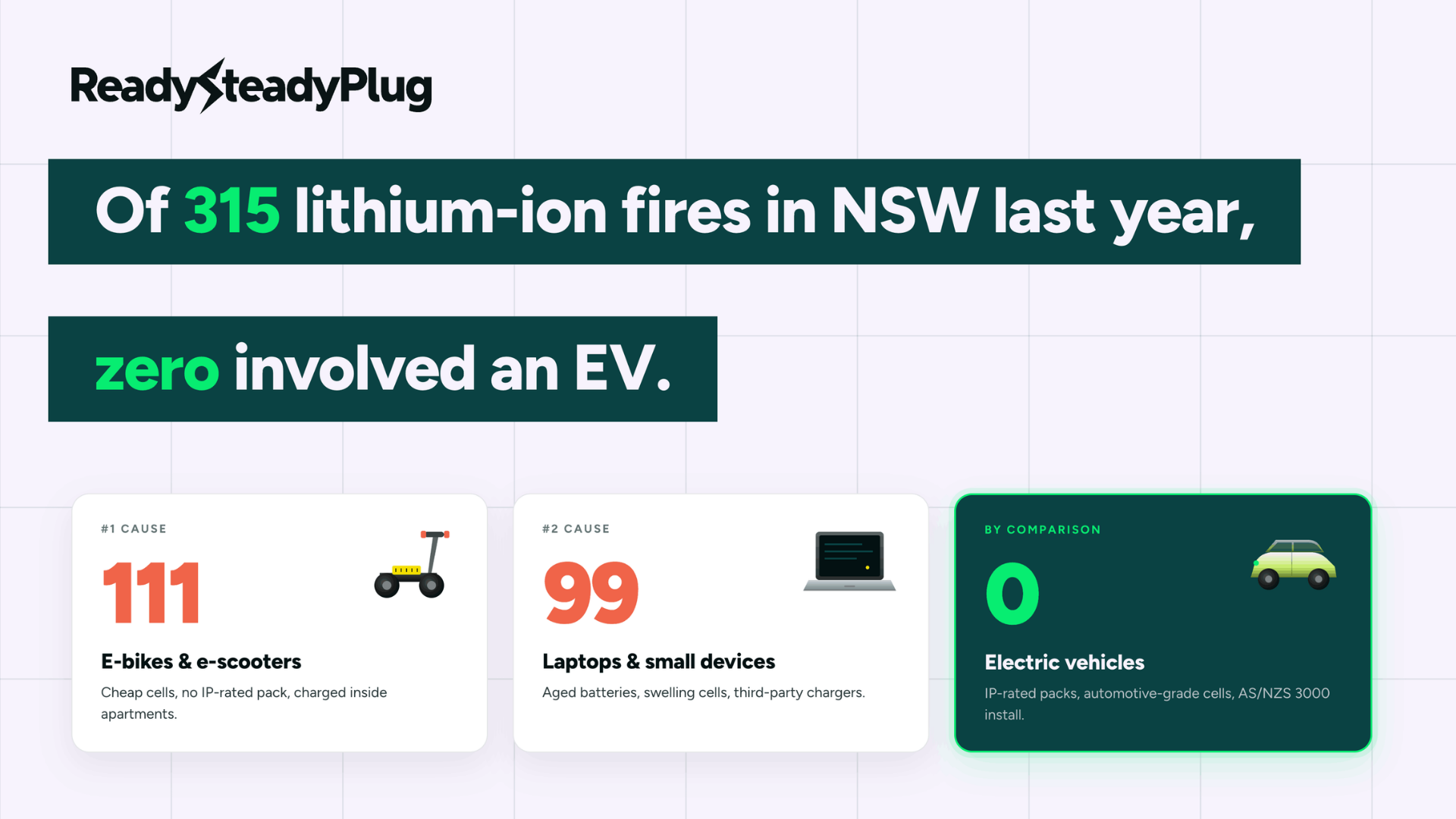
Source: Fire and Rescue NSW Annual Report 2024/25 — of 315 lithium-ion battery fires attended, 111 involved e-bikes/e-scooters, 99 involved small devices like laptops, and zero involved electric vehicles. fire.nsw.gov.au
This is the data point that should reframe the conversation at any committee meeting.
Fire and Rescue NSW reported in its 2024/2025 annual report that none of the 315 lithium-ion battery fires it attended that year involved electric vehicles. Not one.
The top three culprits were:
E-mobility devices (e-bikes and e-scooters): 111 fires
Small portable devices like laptops: 99 fires
Battery chargers for those devices
According to EV FireSafe's submission to the Insurance Council of Australia, e-bike and e-scooter battery fires are happening weekly in Australia and daily in cities like New York and London. Personal mobility devices are the real lithium-ion threat in residential buildings, not cars.
The reason is straightforward. EVs use very high quality battery cells encased in IP-rated protective packs, and are subject to stringent regulations and testing. E-bikes and e-scooters often are not.
Why properly installed EV chargers are safe in Australia
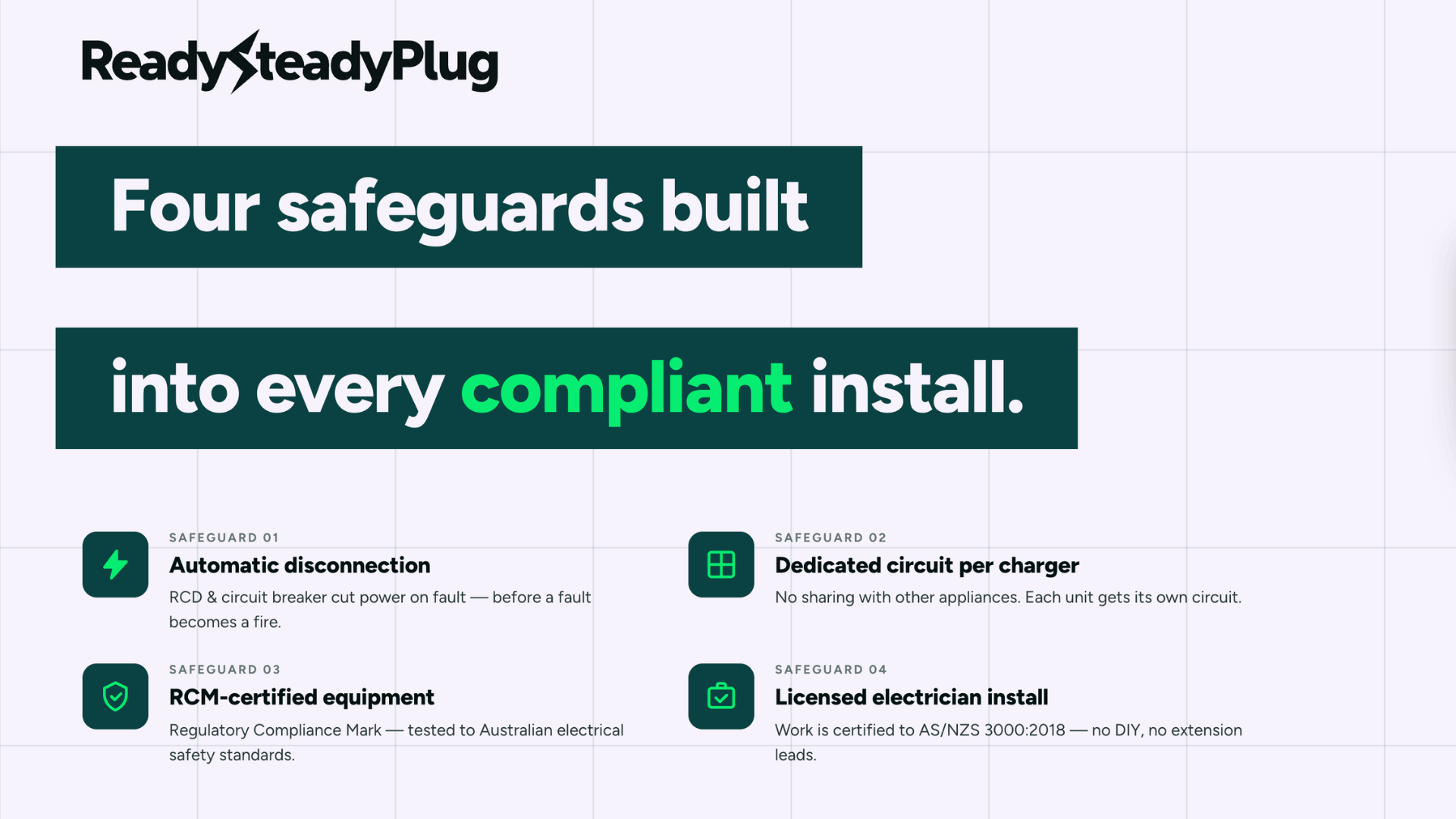
Source: AS/NZS 3000:2018 "Wiring Rules", Standards Australia. standards.org.au
Australia has a strong compliance regime that directly mitigates EV charging fire risk. Any charger sold and installed in this country has to meet it.
The key safeguards:
AS/NZS 3000:2018 (Wiring Rules), Appendix P requires automatic disconnection of power in the event of a fault, via a Residual Current Device (RCD) and circuit breaker
Dedicated circuit per charger. Each EV charger must have its own dedicated circuit. No sharing with other appliances
Regulatory Compliance Mark (RCM) is required on every compliant charger sold in Australia, certifying it has passed Australian electrical safety testing
Licensed electricians only. Installation must be done by a licensed electrician, with the work certified
When these conditions are met, a charger is one of the safer high-load electrical installations in a building. The fire safety systems are designed to disconnect the power before a fault becomes a fire.
What about Level 1 vs Level 2 charging?
The same standards apply. Both are governed by AS/NZS 3000 and both must use RCM-certified equipment.
Level 1 charging (10A-15A) draws less current and produces less heat than Level 2, and uses standard general power outlets that are already common in basement car parks. The lower power draw means less electrical stress on building infrastructure overall.
This is one of the reasons we use Level 1 at RSP. The full reasoning is on our How It Works page.
The risks that DO apply to strata, and how to manage them
The data is clear that EV chargers themselves are not the problem. But there are legitimate considerations for any building installing EV charging, and they should be addressed honestly.
Enclosed car parks need fire detection. Industry guidance from the IET notes that fire risk increases in enclosed spaces like underground car parks. Working fire alarms and sprinkler systems are the best form of active protection. Most strata buildings already have these.
There are no certified EV fire extinguishers. Advice from CSIRO and EV FireSafe, via the Owners Corporation Network of Australia, is that the only effective response to a lithium-ion battery fire is to call 000 and evacuate. No special equipment is required, because no special equipment exists. This is worth communicating clearly to residents.
Damaged EVs should not be charged. If a vehicle has been in a collision or shows visible battery damage, it should be inspected before being plugged in.
Use compliant equipment, installed by licensed electricians. This is the single most important risk control. Non-compliant chargers and DIY installations using extension leads are the real hazard.
What strata managers and committees can actually do
If your committee is weighing up EV charging and fire safety is on the agenda, the practical actions are:
Insist on RCM-certified charging equipment from a known supplier
Confirm installation is carried out by a licensed electrician to AS/NZS 3000:2018
Make sure the building's fire detection and sprinkler systems are current and tested
Communicate to residents that e-bike and e-scooter charging inside apartments is a higher risk than EV charging in the car park
Refer questions about emergency response to local fire services, not to social media
The Owners Corporation Network of Australia has a useful fact sheet on lithium-ion battery fire risk in apartment buildings, and EV FireSafe runs training specifically for strata committees and owners corporations.
The bottom line
EV chargers, installed correctly and to Australian standards, are safe. The data is clear and the regulatory framework is robust.
The bigger lithium-ion fire risk in any apartment building today comes from the e-bike or e-scooter charging in an upstairs hallway, not from the car plugged in downstairs.
Banning EV charging in a building does not reduce risk. It often pushes residents toward unsafe workarounds: extension leads run from apartments, non-compliant portable chargers, or charging at unmanaged public sites. A compliant, professionally installed system is the risk control, not the risk.
If you would like to talk through how this applies to your building, or what a compliant EV charging install actually looks like in a strata context, let's have a chat.
About ReadySteadyPlug
ReadySteadyPlug delivers managed Level 1 EV charging built for Australian strata buildings: individual metering per resident, Dynamic Load Management so most buildings avoid switchboard upgrades, and systems that work in basements without Wi-Fi. All equipment is RCM-certified and installed to AS/NZS 3000:2018.
To see if it fits your building, let's have a chat.
Sources referenced:
EV FireSafe (funded by the Australian Department of Defence)
