
Types of EV Chargers: Level 1, 2 & 3 Explained
Shopping for an EV, or working out how you will keep one charged? You will quickly run into three types of EV charger, usually called Level 1, Level 2 and Level 3. Each one charges at a different speed, costs a different amount to run and install, and suits a different situation.
This guide breaks down the three charger types, how they compare, and how to choose the right one, whether you have a driveway, a workplace bay or a parking space in a strata building. (For the bigger picture, see our complete guide to strata EV charging.)
Level 1 (AC trickle charging)
Level 2 (AC faster charging)
Level 3 (DC fast charging)
So, what’s the difference?
The key differences between Level 1, Level 2 and Level 3 EV chargers

Different levels of Electric Vehicle (EV) charging
| Level 1 | Level 2 | Level 3 | |
|---|---|---|---|
| Charger type | AC trickle | AC | DC fast |
| Power | 1.8 to 3.5 kW | 7 to 22 kW | 25 to 350 kW |
| Range added per hour | ~13 to 25 km | 40 to 150 km | 150 to 400 km+ |
| What it plugs into | Standard 230V outlet (GPO) | Dedicated charging station | Dedicated DC charging station |
| Where you find it | Home and strata car parks | Home, workplaces, shopping centres, public | Highways and urban fast-charging hubs |
| Install cost | Low | Moderate to high | Very high (operator) |
| Best for | Daily driving and overnight charging | Faster top-ups at home or in public | Long road trips and quick top-ups |
Level 1 is the most basic and accessible charger type. It uses a standard 230 volt household socket outlet (GPO), delivering around 1.8 to 2.3 kW from a 10A outlet and up to 3.5 kW from a 15A outlet. This adds roughly 13 to 25 kilometres of range per hour: slow but steady, and ideal for overnight charging if you drive short distances each day (under 200 km). No special hardware or dedicated circuit is required, which makes it the easiest charger type to live with.
In Australia, where the average daily commute is around 35 kilometres, Level 1 charging can replenish a day's driving in just a few hours. That covers most drivers who do not need to clock up big distances daily.
If you would rather not charge every day, Level 1 will take you from 20% to 80% in around 15 hours on a 2.3 kW outlet, or around 10 hours on a 3.5 kW outlet (based on a 60 kWh battery). With the 3.5 kW option, plug in at 10pm and you are at 80% by 8am.
The table below shows the approximate time to charge from 20% to 80% for popular EV models, at both 2.3 kW and 3.5 kW.
| Vehicle | Battery (kWh) | Charge time @ 2.3 kW | Charge time @ 3.5 kW |
|---|---|---|---|
| Hyundai Ioniq 5 | 77.4 | 20.2 hours | 13.3 hours |
| Audi e-tron GT | 93.4 | 24.4 hours | 16.0 hours |
| Mini Cooper EV | 40.7 or 54.2 | 10.6 or 14.1 hours | 6.9 or 9.3 hours |
| Tesla Model 3 Standard | 50.0 | 13.0 hours | 8.6 hours |
| Tesla Model 3 Long Range | 80.0 | 20.9 hours | 13.7 hours |
| Tesla Model Y Standard | 60.0 | 15.7 hours | 10.3 hours |
| Tesla Model Y Long Range | 75.0 | 19.6 hours | 12.9 hours |
| BYD Atto 3 Standard | 49.8 | 13.1 hours | 8.6 hours |
| BYD Atto 3 Extended | 60.5 | 15.8 hours | 10.4 hours |
| BYD Seal | 61 to 82 | 15.9 to 21.4 hours | 10.4 to 14.0 hours |
Level 2 AC Charging
Level 2 is a clear step up in speed, delivering between 7 and 22 kW through a dedicated charging station. That adds anywhere from 40 km up to 120 or 150 kilometres of range per hour, which is why it is common in cheaper public charging infrastructure.
Unlike Level 1, this charger type needs a dedicated unit and circuit. Some people install Level 2 at home, but it is more expensive and may require a switchboard upgrade, which adds to the cost. You will more often find Level 2 chargers at workplaces, shopping centres and other public locations. For the average Australian driver, a Level 2 charger can replace a day's worth of driving in about an hour, which makes it a great option to plug into while you do the shopping.
Which charger type is best for an apartment or strata building?
For most apartment and strata residents, Level 1 is the right charger type. It uses a standard outlet, needs no expensive hardware, and overnight charging comfortably covers an average day's driving. The catch in a strata building is rarely the charger, it is the building's electrical supply. You cannot simply install a charger at every parking bay and expect the supply to cope if everyone plugs in at once.
This is where Dynamic Load Management (DLM) comes in. DLM intelligently shares the building's available power across every connected charger, ramping each one up or down in real time so the total never exceeds what the supply can safely handle. Cars still charge overnight, and the building avoids an expensive supply or switchboard upgrade. That combination, Level 1 chargers managed by DLM, is what makes EV charging viable for a whole strata complex, and it is up to 80% cheaper than rolling out Level 2.
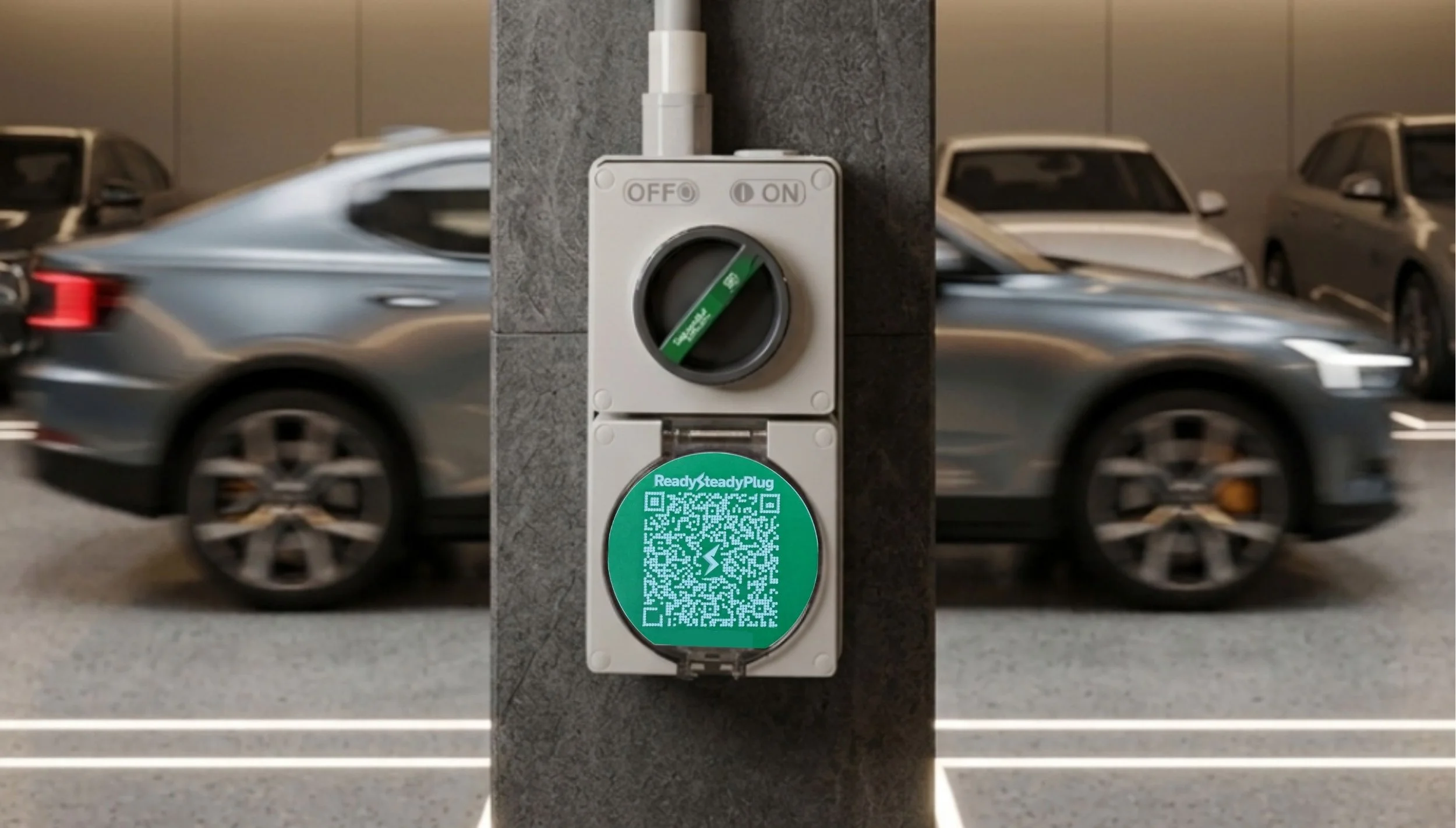
Which EV charger type is right for you?
The right charger type comes down to your driving habits and where you park. Level 1 suits the majority of drivers and is the most cost-effective, which is exactly why we at ReadySteadyPlug focus on it for strata buildings. Level 2 offers faster charging at home (if cost is not an issue and your electrical infrastructure supports it) or in public. Level 3 delivers unbeatable speed for drivers who regularly travel long distances or need a fast top-up.
Understanding the three charger types puts you in a much better position to choose.
If you live in a strata building and want to know what is possible for your car park, get in touch with us today.
ReadySteadyPlug focuses on Level 1 chargers within strata complexes as it meets most driver’s needs and is up to 80% cheaper than Level 2 charging solutions.
Contact us today!
Frequently asked questions about types of EV chargers
-
There are three: Level 1 (AC trickle charging via a standard outlet), Level 2 (faster AC charging through a dedicated station), and Level 3 (DC fast charging). They differ in speed, cost and where you typically find them.
-
Level 1 and Level 2 both use AC power, with Level 2 being the faster of the two. Level 3 uses DC power for the fastest charging available. Level 1 adds about 13 to 25 km of range per hour, Level 2 adds 40 to 150 km, and Level 3 adds 150 to 400 km or more.
-
Level 1 charging is usually best for apartments and strata buildings. It uses a standard outlet, needs no expensive hardware, and when paired with Dynamic Load Management it lets a whole building charge without an electrical supply upgrade.
-
Not necessarily. Level 1 charging uses a standard 230 volt outlet, so no dedicated hardware is required. Level 2 charging is faster but needs a dedicated charging station and possibly a switchboard upgrade.
-
Level 1 is the cheapest to install and run. In a strata setting, Level 1 with Dynamic Load Management is typically up to 80% cheaper than installing Level 2 infrastructure.
