
EV Charging in Strata Basement Car Parks: The Wi-Fi Problem Nobody Talks About
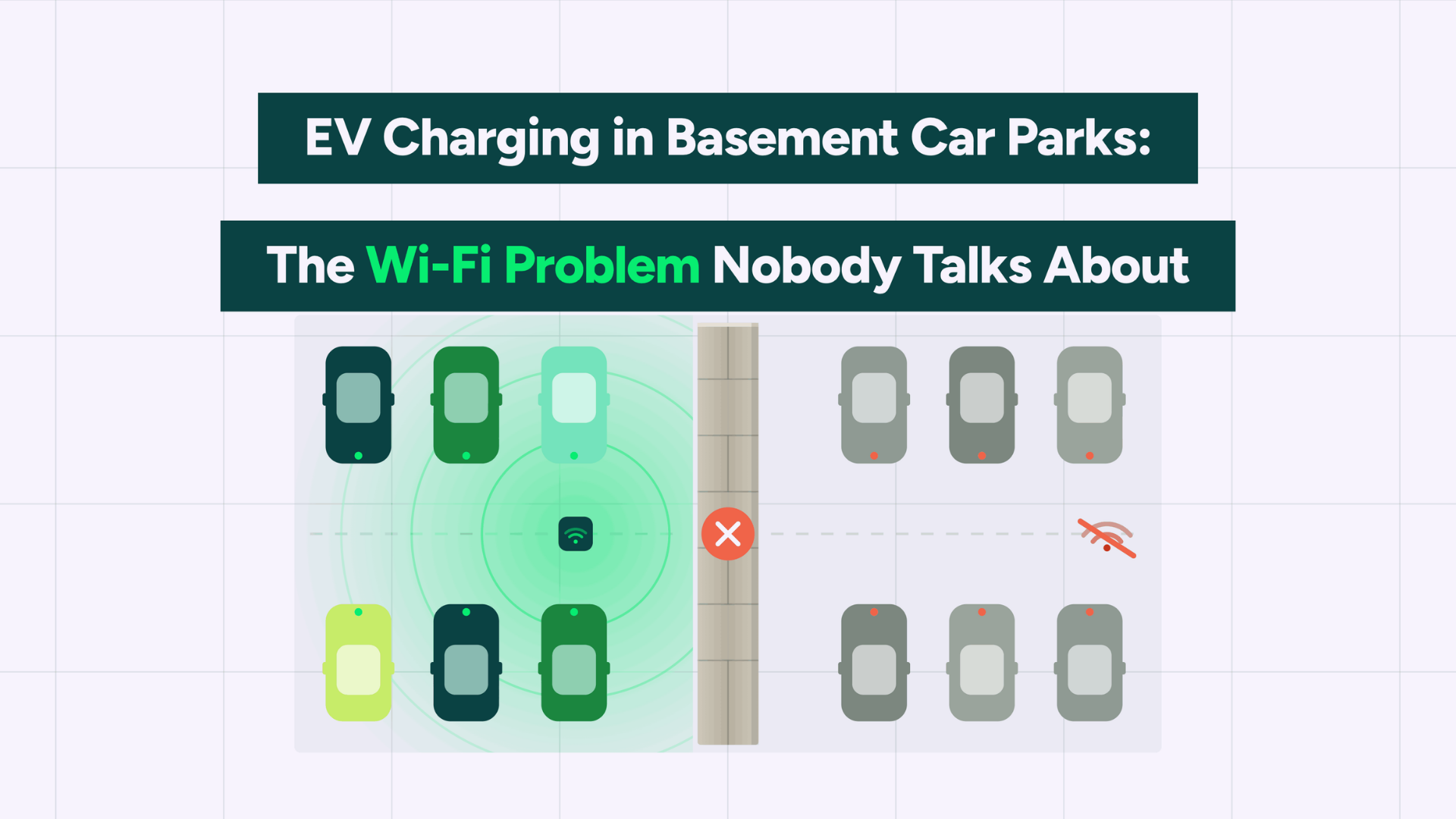
Here is something that does not come up in most EV charging brochures: a lot of smart chargers need an internet connection to work properly. And a lot of strata basement car parks have no internet connection at all.
If your building has underground parking, this is worth understanding before you choose a charging system. Because the wrong choice can leave you with chargers that are less functional than advertised, or that require expensive networking work to get running.
Why most smart chargers need connectivity
Modern EV chargers are not just plugs. They are networked devices. They communicate with a cloud platform to authenticate users, record usage, handle billing, manage load, and update their software. To do all of that, they need to be connected to the internet.
Most chargers do this via Wi-Fi. Some use a cellular (4G/5G) connection instead. The problem is that both of those signals are often poor or non-existent in underground car parks.
Concrete walls and ceilings block radio signals effectively. A basement three levels below ground, surrounded by reinforced concrete on all sides, is exactly the kind of environment where Wi-Fi drops out and cellular coverage disappears.
What happens when a charger loses connectivity
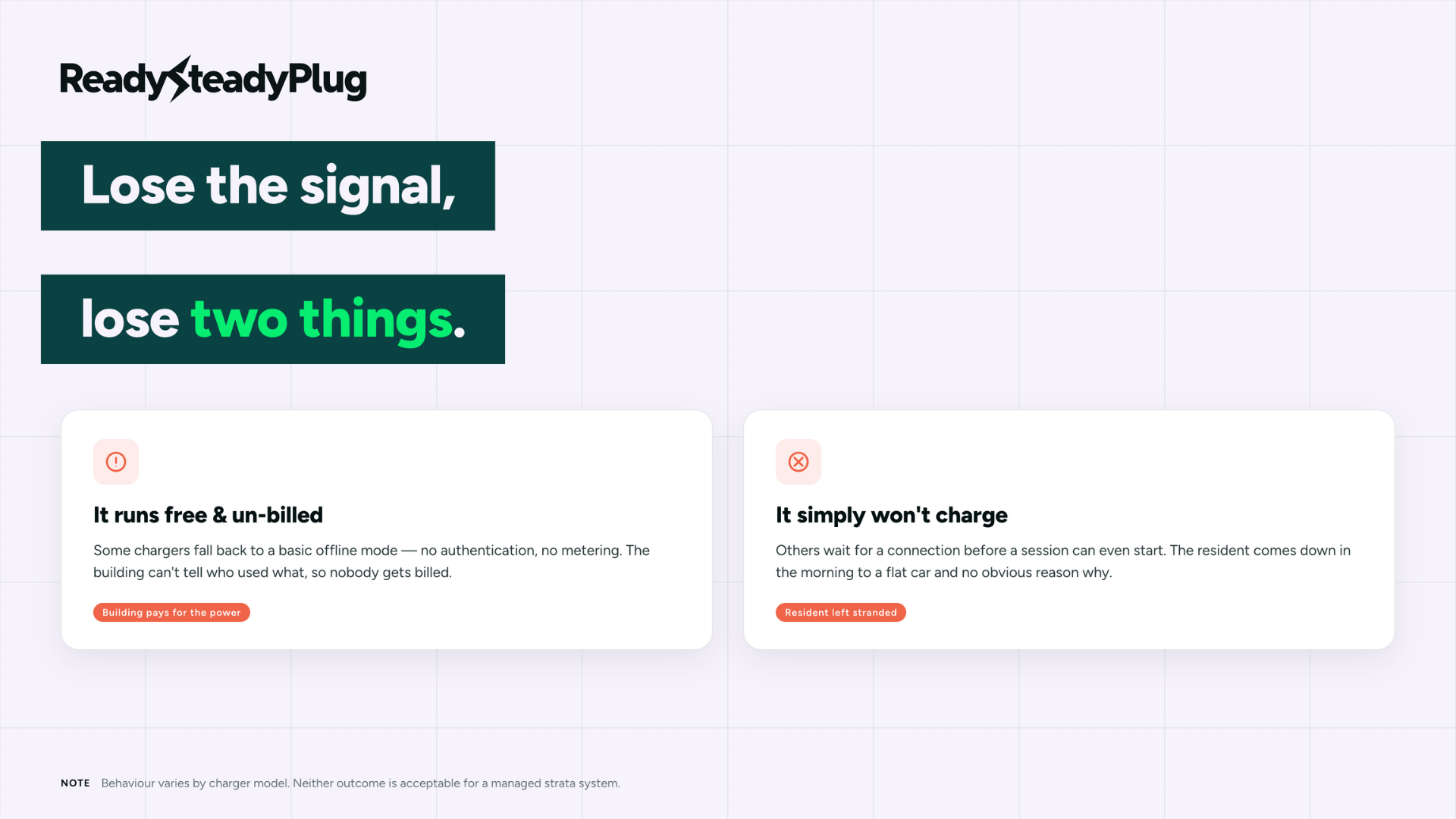
It depends on the charger. Some continue to operate in a basic offline mode, but without authentication or billing. That means the building cannot tell who used what, and residents cannot be charged for their electricity use. The building effectively provides free charging until the connection is restored.
Others simply stop working. They wait for a connection before allowing a charge session to begin. A resident comes down in the morning, their car is still flat, and there is no obvious explanation.
Neither outcome is acceptable for a strata building that is trying to run a fair, managed charging system.
The workarounds, and their costs
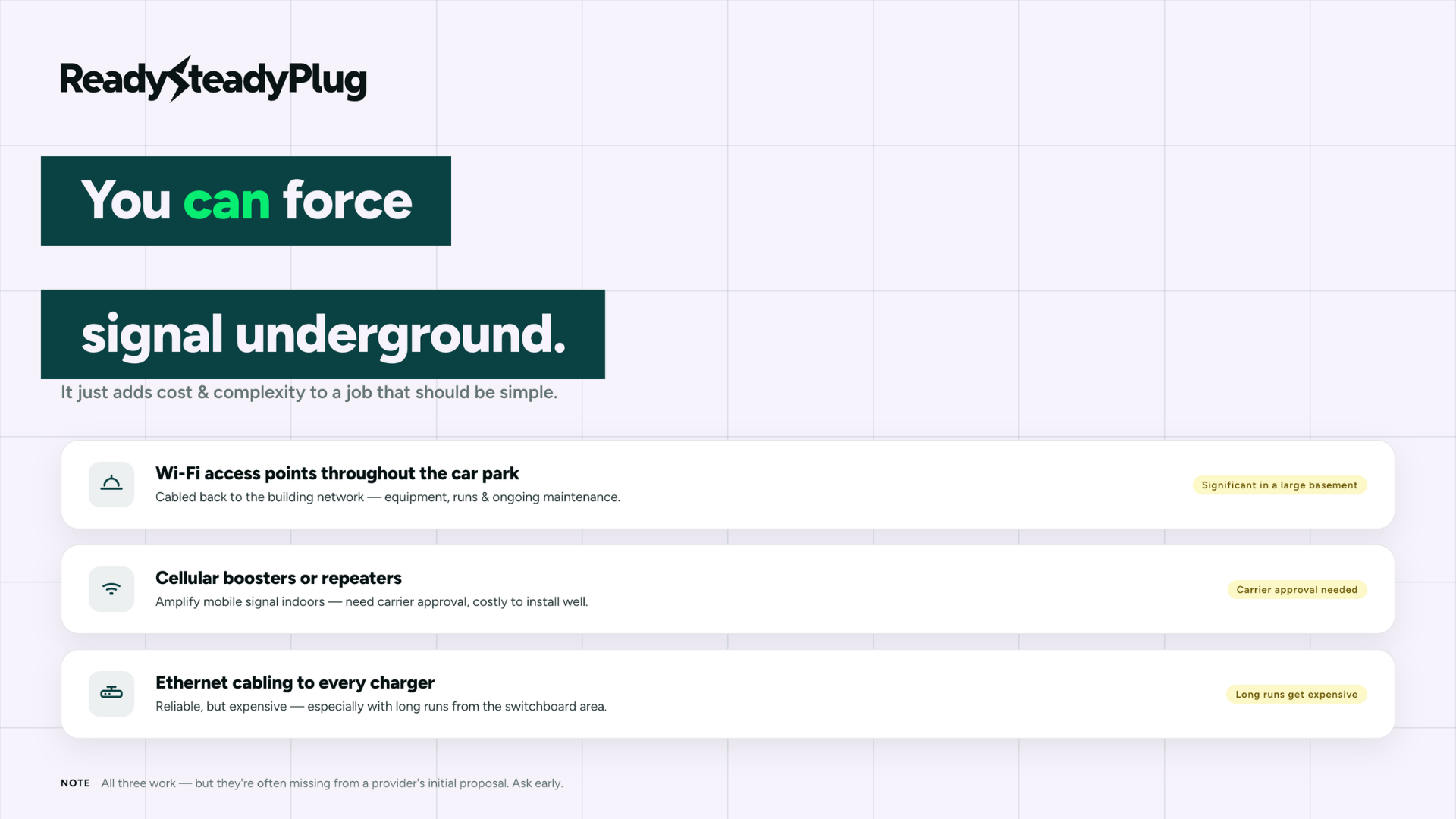
There are ways to get Wi-Fi into a basement car park. They include:
Installing Wi-Fi access points throughout the car park, cabled back to the building's network. This works but requires cabling runs, network equipment, and ongoing maintenance. In a large basement with multiple levels, the cost can be significant.
Installing cellular boosters or repeaters. These amplify the mobile signal inside the building. They require approval from the carrier and can be expensive to install properly.
Running ethernet cabling directly to each charger. This is reliable but expensive, particularly if the car park layout means long cable runs from the main switchboard area.
Any of these can solve the problem. But they add cost and complexity to what should be a relatively straightforward installation. And they are often not included in a charger provider's initial proposal.
A better approach: connectivity that does not depend on the car park
Some EV charging systems are designed to work without relying on Wi-Fi or cellular coverage in the car park itself. Instead, the intelligence sits in a central unit located outside the basement, where connectivity is reliable. The charge points themselves communicate with that unit over a wired connection, so they do not need to reach the internet independently.
This approach is significantly more robust in basement environments. The charge points do not need signal. They just need to be physically wired to the central system, which handles all the cloud communication from a location where connectivity is good.
It is a design decision that does not cost more to build, but requires a provider who has thought carefully about real-world strata environments rather than ideal-case scenarios.
Questions to ask any provider before you commit
If your building has underground parking, ask these before signing anything:
Does the system require Wi-Fi or cellular connectivity at the charge point itself?
What happens to the charger and to billing if that connectivity drops out?
What networking infrastructure would need to be installed in our car park, and what does that cost?
Do you have installations in buildings with underground car parks similar to ours? Can we speak to that strata manager?
A provider that has not thought about these questions is a provider that has not installed many systems in real strata buildings. Push for specifics.
It is a solvable problem, but not all solutions are equal
Basement connectivity is not a reason to avoid EV charging. Buildings with three levels of underground parking have had fully functioning managed charging systems running reliably for years. The Meadowbank case study on our site is one example: three underground levels, no Wi-Fi, no cellular coverage in the car park, and a system that handles authentication, metering, load management, and billing without any of it.
The key is choosing a system designed for that environment, rather than assuming that what works in a surface-level car park will work in a basement.
If your building has basement parking and you are not sure how to approach this, let's have a chat. Connectivity is one of the first things we look at in any new site assessment.
