
Can I install my own EV charger in my apartment car space?
You've bought an EV. You have a car space in the building's car park, and there's probably a power point on a wall not far from it. So can you just get an electrician in, put a charger on the wall, and start charging?
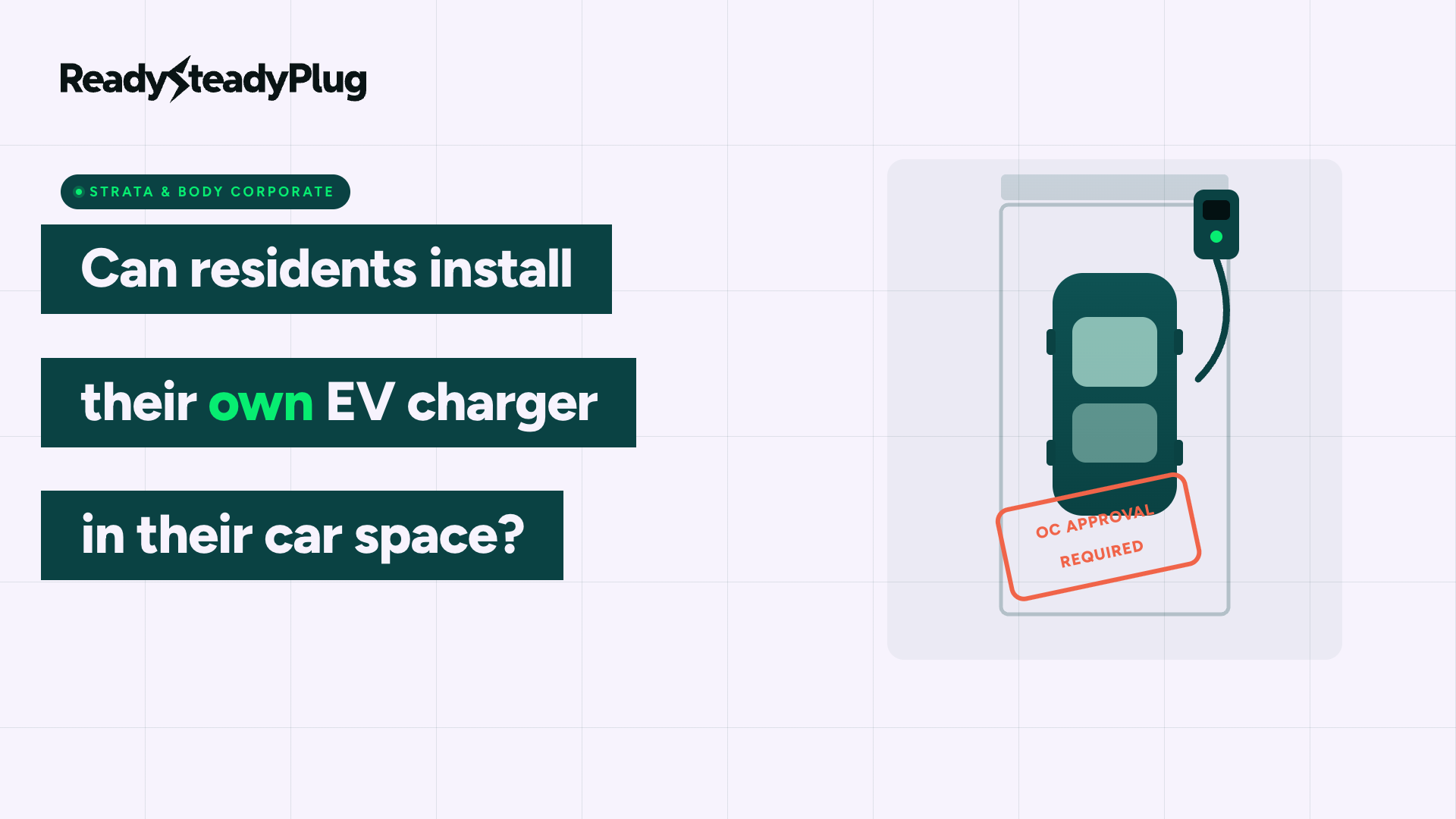
The short answer: not on your own. In a strata building, the cabling that would feed your car space and the switchboard it connects to are usually common property, even if the car space itself is part of your lot. That means any charger needs your Owners Corporation's approval, even for a single space. And even with approval, one-off installs tend to create problems the whole building ends up living with.
The better path is a managed, building-wide system that any owner can connect to. And if you're the first EV owner in your building, you can still be the first to charge at home. Here's how it all fits together.
Why can't I just get an electrician to install a charger?
There are four reasons, and most buildings run into all of them.
1. You need your Owners Corporation's approval. Running new cable through the car park and connecting to a shared switchboard is work on common property. It usually needs a by-law or a resolution passed at a general meeting. This is true whether your car space is on title, an exclusive-use area or a common property space allocated to you: the space might be yours, but the wiring that reaches it almost never is.
2. Your meter is probably nowhere near your car space. Your apartment's electricity meter is often floors away from a basement car park, so wiring a charger to your own meter is often not practical. The easy alternative is to connect to common power, but then the Owners Corporation pays for your charging unless every kWh is metered and billed back to you.
3. Your building's power supply is shared. Every apartment, lift, pump and light draws from the same supply. Each unmanaged charger adds load on top, often in the evening when the building is already busy. The first few chargers use up the spare capacity, and the owners who come later may be told there's none left, or face an upgrade that everyone pays for.
4. Basements and smart chargers don't mix well. Many wall chargers need Wi-Fi or mobile reception to be controlled and billed. Underground car parks often have neither.
What goes wrong when a building approves chargers one at a time?
The first charging request a committee approves quietly becomes the building's policy. Approve three or four one-offs and the building usually ends up with:
- A mix of hardware, installed by different electricians, each on its own terms
- Nobody watching the building's total electrical load
- Arguments about who pays for the electricity
- Later residents locked out because the spare capacity has gone to the early adopters
None of this is a reason to say no to EV charging. It's a reason to decide how the building will handle it before the requests pile up, rather than sorting it out afterwards.
What does managed EV charging actually mean?
A managed system treats EV charging as shared building infrastructure rather than a string of private add-ons. With ReadySteadyPlug, that looks like this:
- A backbone designed for the whole car park. EV Charging Distribution Boards are installed once, sized so more car spaces can connect over time.
- Your own circuit and outlet. Each Charge Point is a standard 15 A outlet with its own dedicated, individually metered and protected circuit.
- You pay for what you use. Every Charge Point is billed to you through the app. The Owners Corporation is reimbursed for the electricity every quarter, and non-EV owners pay nothing towards your charging.
- No major infrastructure upgrade in most buildings. Dynamic load management monitors the building's supply in real time and keeps EV charging within the capacity that's actually available.
- No Wi-Fi needed at your car space. The intelligence sits in the distribution board, so it works in underground car parks with no reception.
- No minimum number of users. A building can start with one active user and add more Charge Points as EV numbers grow.
Who pays for it?
The Owners Corporation chooses one of two ways to fund it:
- The Owners Corporation funds the backbone, and each resident who wants a Charge Point pays for their own.
- Nothing upfront from the Owners Corporation. The backbone cost is absorbed into a higher price per Charge Point, funded by the residents who opt in.
Either way, you then pay for the electricity you use through the app, and new residents can join later at no extra cost to the strata.
Can I still be the first EV owner in my building to charge at home?
Yes. With your Owners Corporation's approval, we can install a small starter distribution board connected to the nearest house switchboard, together with one Charge Point for you. It's sized so other owners can connect to it later without starting again, and new boards can be added once the starter board is full. You get charging now, and the building gets a foundation it can grow into instead of a one-off it has to work around.
What do the rules say?
It depends on your state.
New South Wales. EV charging is treated as sustainability infrastructure under the Strata Schemes Management Act. A sustainability infrastructure resolution passes unless more than half the unit entitlements vote against it, rather than needing the usual three-quarters. Since 1 July 2025, an Owners Corporation also can't refuse sustainability infrastructure purely on aesthetic grounds unless the property is heritage listed. More on the NSW changes.
Victoria. See Consumer Affairs Victoria on owners corporations and the Victorian Government's page on EV charging in strata buildings.
Queensland. The Commissioner for Body Corporate and Community Management publishes a fact sheet on electric vehicles in bodies corporate.
This is general information, not legal advice. Your strata manager can confirm the position for your scheme.
How do I raise EV charging with my Owners Corporation?
Many of our buildings started with one owner raising it at a committee meeting. Here's how to do it:
- Talk to your committee or strata manager. Tell them you'd like EV charging and that you'd rather it was done properly for the whole building.
- Propose a building-wide approach, not a one-off approval for your space. It's an easier yes, because it answers the fairness, capacity and billing questions up front.
- Get the committee pack. We provide a two-page overview, a step-by-step guide for Owners Corporations, template by-law and motion wording, an expression-of-interest form and a flyer for the lifts.
- Send us the building's plans. Strata plan drawings and a single line diagram of the switchboards are enough for us to start.
You can do steps 3 and 4 through our Get Started form. For the full process from first conversation to first charge, read how to get EV charging in your apartment building, step by step.
Frequently asked questions
Do I need strata approval to install an EV charger in my car space? Yes. Car park cabling and switchboards are usually common property, so the Owners Corporation needs to approve any charger, even for one space, and even if the car space is on your title.
Is a body corporate the same as an Owners Corporation? Yes. Queensland uses the term body corporate; NSW and Victoria use Owners Corporation. Either way, their approval is needed for work on common property.
Can I just plug my car into an existing power point in the car park? Not without permission. Car park power points usually run on common property electricity, so the Owners Corporation would be paying for your charging. A managed Charge Point meters your usage and bills it to you.
Who pays for the electricity with a managed system? You do, from your own card in the ReadySteadyPlug app. Nothing is added to strata levies, and the Owners Corporation is reimbursed every quarter.
What if the rest of my building isn't ready? With Owners Corporation approval, a starter board and a single Charge Point can go in for you now, ready for others to join later.
Do I need to buy a wall charger? No. A Charge Point is a standard 15 A outlet, so you use the portable charger that came with your car or an after-market 15 A portable charger.
Sources and further reading
- Installing a personal EV charger: a guide for strata residents (Australian Government, energy.gov.au)
- Making your residential strata building EV ready (NSW Climate and Energy Action)
- EV charging in strata buildings (Victorian Government, energy.vic.gov.au)
- Electric vehicles in bodies corporate fact sheet (Queensland Commissioner for Body Corporate and Community Management)
- Strata EV charging: the complete guide for Owners Corporations (ReadySteadyPlug)
